Bhitar-Kanika!
A love story!
Bhitarkanika! The story of how did I fall in love with this place.
I always loved Kingfishers. During my childhood, a Common Kingfisher fascinated me with its shining blue colours sitting right next to me and that was one of the key reasons that made me fall for wildlife. I always wanted to see different types of Kingfishers in their natural habitat. When I was done with all types of them from southern India, I came to know that Bhitarkanika is the best place to see Brown-winged Kingfishers. So I planned my winter birding at Orissa, Bhitarkanika just for the kingfisher, then Mangaljodi and Chilika for aquatic birding. My stay was just for one night at Bhitarkanika. I knew the least about this place then.
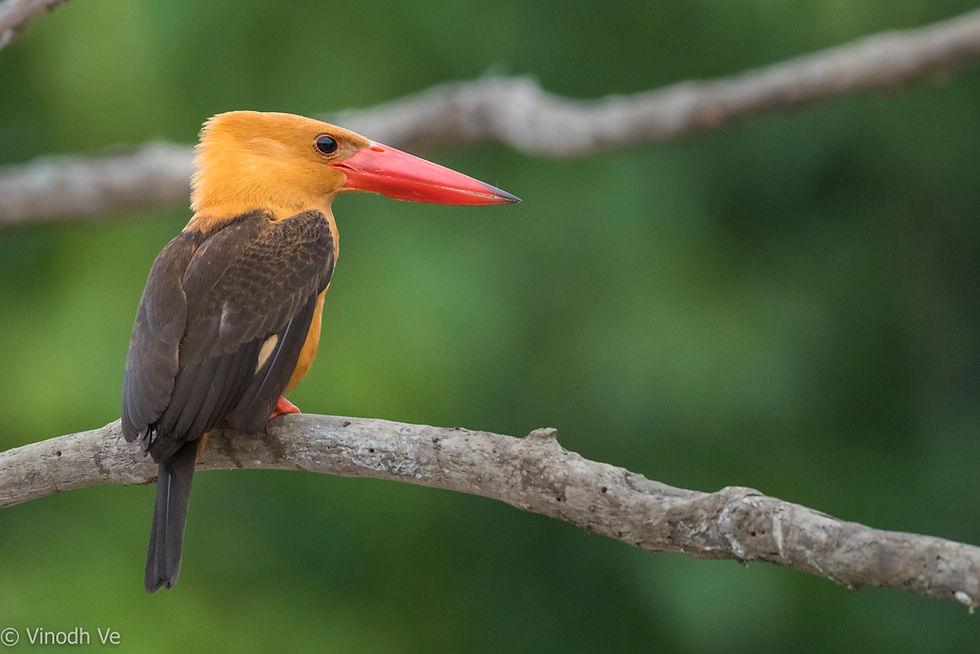
I reached Bhitarkanika little late than planned and we didn't had much time to waste. So we quickly started our boat ride in search of Brown-winged Kingfisher. Within 15 minutes, we saw one sitting very low. They were so confident and were not flying away like other species. Once saw the kingfisher and when the pressure got released, I started observing the place.
We were boating through a beautiful mangrove forest. The weather was humid with pleasant breeze and the forest was rich with wildlife. We saw different types of kingfishers - White throated, Pied, Collared, Black capped, Common, etc., and many other birds like Herons, Egrets, Sandpipers, Shanks, Cormorants, Sea eagles, Snake eagles, Honey Buzzards, etc. There were many Salt water Crocodiles and Water Monitors at the banks of the mangroves.
Our guide, Mr.Bijaykumar Das, started telling fascinating jungle tales of Bhitarkanika. This place is usually popular among wildlife enthusiasts just for the Brown-winged Kingfisher and the Mangrove Pitta, known as the King and the Queen of Bhitarkanika. But this place homes a very unique wildlife that one would never see or experience anywhere else.

There are no tigers or elephants or leopards here unlike many parts of the Indian jungles we generally know. The Spotted deers here, gives alarm call for the Salt water Crocodiles. There are Pythons and King cobras more commonly found in the forest patches, closer to human settlements.
I stayed in the forest rest house, a huge and very old property close to the mangroves. It was a property with blocks - rooms to stay, interpretation center, canteen, etc., separated to each other. I have to walk around 500 meters to reach the canteen for food. On my way to canteen for dinner, I found couple of crocodiles resting in the walkway. I was scared with such unexpected wild encounter, but I realised that was a common sighting there.
In the night, I was excited to see 3 Indian Porcupines raiding the fallen fruits of xxx tree right next to the canteen. During dinner, the guide talked about Leopard cat sightings happening within the property. That made me jump out of the chair, as I love lesser cats too. After dinner, I decided to take a walk around the property, to find my luck on any lesser mammals. Surprisingly, I saw pug marks of a lesser cat, most probably of a Leopard cat, in our path. That made me extend the night walk ignoring my tiredness. We walked and walked, saw owls like Oriental & Collared Scops Owl, Spotted Owlets and a Long tailed Nighjar.
All the time, my torch was pointed towards the sides of the mangrove path searching for any wildlife. Never I had checked what was in the path. While shifting the torch, suddenly I saw a huge thing crossing the path in hast, very close to my foot. That was a Common Krait snake! My first sighting of a live specimen. That was too close, I should say. The snake crossed the path, realised the presence of us around it with torches. It tried hiding in the leaf litter and within no time, it vanished completely. Now no one will believe there is a 5 foot snake right infront of us in the leaf litter. That moment, a chill passed over my spine. I remembered we saw few shedded snake skin on our way. Then I realised, there could be Kraits anywhere we step. Then onwards, my torch stayed on the path all time.
During my next trips to Bhitarkanika, I was blessed with Leopard cat and Fishing cats in the night. My first Leopard cat sighting was a sweet surprise. We were birding in the forest patch during a hot summer. All of a sudden, we saw an unusual thing shining back-lit in the tree top. That was a cat's paw clearly. On closer look, we saw a sleepy Leopard cat on the branch just around 20-25 feet above the ground. The next night, we headed towards the back water area in search of Fishing cats. We were lucky to see 3 of them at different places. The cat was not bothered at all with our presence and was searching fish in the water.


There is a huge heronry inside the forest where thousands of herons and egrets and cormorants and storks roost. Crocodiles and Monitor lizards are found everywhere. This park is visited by some rarities like Pale capped Pigeons, Chinese Pond Herons, Eye-browed Thrush, Watercock, etc. The amphibians and snakes here are still unexplored. The guide was showing pictures of an un-described Green Pit Viper taken from a temple tree in the village, Huge green frog feeding on fishes, etc.


Our guide Bijay Kumar Das is a Research Assistant at Bhitakanika National Park, Odisha. He is a down-to-earth person with a great passion and pride towards Odisha wildlife. His knowledge on Odisha birds is phenomenal and he cannot go wrong with his prediction on birds with his years of experience. While people visit Bhitarkanika for birds, I really admire Bijay, listening to his wildlife experiences around the place. Another impressive thing about Bijay is the way he treats the guests. He is committed to the saying ‘adhiti dhevo bhavah!’. He is bringing up his son as well into a naturalist and hope to find another Bijay for the park.
About Bhitarkanika:
Bhitarkanika is formed from two Odia words 'Bhitar' meaning interior and 'Kanika' meaning that which is extraordinarily beautiful. Bhitarkanika National Park is located in Kendrapara district of Odisha spreading over 672 km2. It was designated as national park on 16 September 1998. Gahirmatha Beach and Marine Sanctuary lies to the east, and separates swamp region cover with canopy of mangroves from the Bay of Bengal.
The park is home to the saltwater crocodile, Indian python, black ibis, wild boar, rhesus monkey, chital, darter, cobra, monitor lizard. Olive ridley turtles nest on Gahirmatha and other nearby beaches. Bhitarkanika has one of the largest populations of endangered saltwater crocodile in India and is globally unique in that, 10% of the adults exceed 6 m length. Around 3,000 saltwater crocodiles were born during 2014 annual breeding and nesting season. In 2006, Guinness Book of World record accepted claims of a 7.1 m (23 ft 4 in), 2,000 kg male saltwater crocodile living within Bhitarkanika National Park.
Mammals that are found here are Chital, Wild Boar, Rhesus Macaque, Grey Langur, Smooth coated Otter, Sambar deer, Leopard cat, Fishing cat, Jungle cat, Grey Mongoose, Indian Jackals, etc. I have heard about Striped Hyena sightings from the locals but nothing recent.
Plan a trip:
Weather: Usually Bhitarkanika is a humid place throughout the year. Winters are pleasant comparatively with temperature ranging between 15 to 28*C. Summers can touch even 45*C sometimes. The park is closed for monsoon between June to Oct, and usually rains start hitting from Apr end onwards.
Accommodation: Accommodation is available at forest rest houses in and around the park at nominal costs. For bookings contact the Divisional Forest Officer, Rajnagar (Tel.: 06729-8460).
Forest Rest House, Chandbali. Accessible from the highway at Bhadrakh.
Forest Rest House, Dangmal. At this rest house located deep within the reserve, suites and dormitory facilities are available.
Forest Rest House, Gupti. Dorm arrangements can be availed of at the rest house located in the heart of the reserve.
Forest Rest House, Ekakula. The rest house is located at the beach and offers suites and a dorm.
Forest Rest House, Habalikhati. A Dormitory is available for stay at the rest house located on the beach of the Marine National Park.
Transport:
By Air: The Bhubaneshwar airport is 190 km. away.
By Rail: Bhadrakh (77 km.) is the nearest railhead.
By Road: Chandabali, 35 km. away is the nearest town. It is 160 km. from Cuttack. Dangamal is the starting point of the Park. The most convenient route from Bhubaneshwar is via Rajnagar.
Best time to visit:
Bhitarkanika is open through out the year but boating is closed during monsoon between June to Oct.
Life in here changes drastically based on the season of the year. Winters being the best time for migratory birds and summers for resident breeding birds like Mangrove Pitta.
Mar-Jun: Best time for Mangrove Pitta, Cuckoos, Owls, etc., along with lesser mammals like Fishing cats, Leopard cats, etc. Temperature during day will be around 36°C to 42°C and nights will be pleasant where the temperature can drops to 22°C to 25°C.
Aug: Best time for Salt water crocodile nesting and hatchlings.
Oct-Feb: Best time for migratory birds and kingfishers like Brown winged, Common, Collared, Black capped, White throated, Pied, etc. One can find migratory birds Eye browed Thrush, Pacific Golden Plovers, Chinese Pond Heron, etc.
Gallery from Thar desert trip, Sep 2015.
DSC_4058
Comments