A Little Tailor's Trust
The Common Tailorbird that chose my backyard.
I didn't go looking for this story. It came and nested right outside my window.
For five years now, a pair of Common Tailorbirds has been breeding in my backyard in Palakkad. Same pair or their descendants — I can't say for sure. But every year, without fail, sometime around mid-April, the familiar loud calls start up again. And I know — they are back.
It starts with the courtship. Loud, energetic calls from early morning, mostly between the mango tree and the kitchen garden. The male calls repeatedly, almost non-stop, especially in the mornings and evenings. The whole neighbourhood knows when the Tailorbird season has begun.

First Things First — Finding the Right Spot
Before any nesting begins, there is a whole week or more of scouting. They hop around the backyard, check the garden, disappear into the mango tree, come back out, check the croton plants, vanish again.
I have seen them peek through the mango leaves so carefully — just a tiny eye and a rufous crown visible between the leaves — checking if the spot is safe before committing to it.
They almost always choose the large-leaved croton plants. The broad leaves give them the perfect material to work with. Sometimes they go for the middle of the mango tree instead. But wherever they choose, the location is never obvious. You have to really look.


Who Is the Common Tailorbird?
Scientific name: Orthotomus sutorius. The species name sutorius comes from the Latin word for cobbler or tailor — a nod to exactly what this bird does. It stitches. Literally.
The Common Tailorbird belongs to the family Cisticolidae and is found across South and Southeast Asia. In India, it is one of the most widespread and adaptable small birds — equally at home in dense forests, village gardens, and gardens and backyards like mine in Palakkad.
A few things that make it easy to identify:
· Bright rufous (chestnut) cap — the most distinctive field mark
· Olive-green upperparts, whitish underparts, with a faint dark spot on the throat
· A long, cocked tail that bobs and jerks as it hops — unmistakable
· Males grow elongated central tail feathers during the breeding season
· The call is a loud, repetitive 'tuweet-tuweet-tuweet' — you will hear it well before you see the bird
Size-wise, this is a very small bird — about 10–14 cm. But what it does with that tiny body is nothing short of extraordinary.
The Nesting — Where the Magic Happens
Once the spot is chosen, the real work begins.
They are active throughout the day during nesting — no breaks, no wasted trips. Every visit to the backyard brings back something: a strand of cotton, a spider web, a piece of plant fibre. I have watched them pull cotton from old cushions left outside, collect fluff from flower pots, and search the walls and rope for any soft material.
They sleep in the mango tree at night and start again at first light the next morning. Same routine, every day, until the nest is complete.

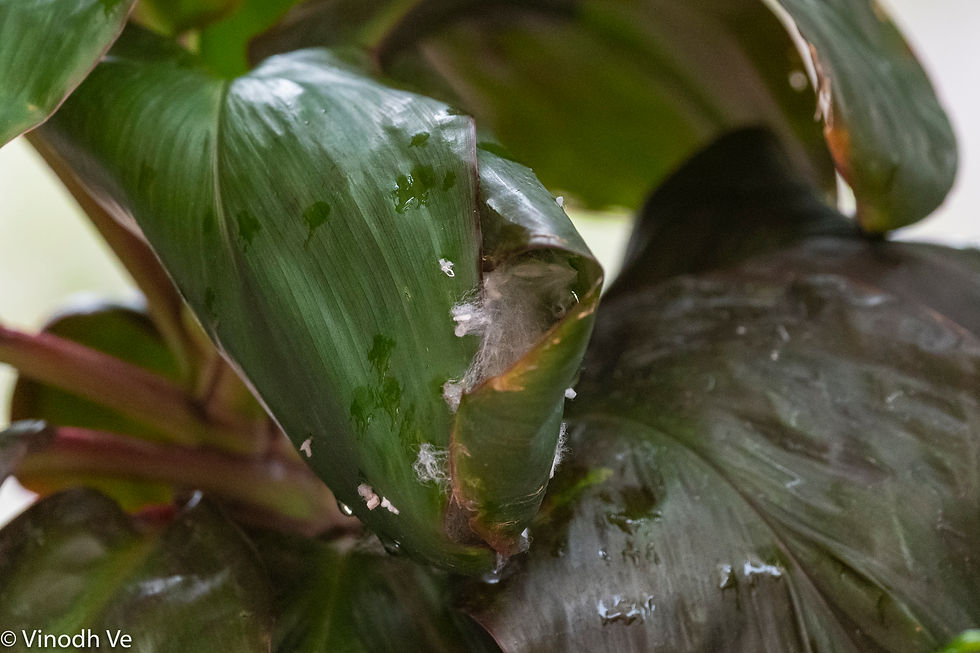

The Nest — Nature's Most Impressive Stitchwork
The Tailorbird's nest is genuinely one of the most remarkable constructions in the bird world.
The bird does not cut leaves. It stitches them — while they are still alive and attached to the plant. Using its pointed bill like a needle, it punches holes along the edges of one or two large leaves and then threads plant fibres, spider silk, or cotton through the holes, pulling them tight to draw the leaf edges together into a cone or pouch shape.
Inside this leaf pouch, it builds a soft cup of cotton, plant down, and fine fibres where the eggs will be laid.
A few things that make this nest remarkable:
· The stitches are tied with knots — actual knots — at each end so they don't slip through
· The living leaf stays green and camouflaged, making the nest nearly invisible from outside
· Spider silk is preferred because it is elastic — the nest expands slightly as the chicks grow
· The whole structure is usually completed in 3–5 days
· Croton plants with large leaves are a favourite precisely because the leaf is strong enough to hold the stitches without tearing
What makes it even more impressive is that the bird has no hands. Just a beak, two feet, and a very clear idea of what it wants to build.
The Wait — and Then the Chicks
Once the nest is ready, the female typically lays 2–4 eggs. In my backyard, it has almost always been 2 chicks that make it.
The incubation takes about 12 days, with both parents taking turns. Then comes the part I look forward to every year — watching the chicks grow.
When they first appear, they are tiny, scruffy, and completely unrecognisable as the elegant birds their parents are. All fluff, wide orange gape, and big eyes.
But they grow fast. And when they are ready to leave the nest — usually around 3 weeks — you can see the struggle. They hop to the edge, look down, hop back. The parents call from nearby trees, encouraging them. And then, one at a time, they make that first flight.
I have watched this five times now. It never gets old.


Breeding and Family Life
Common Tailorbirds can breed 2–3 times a year in India, particularly in tropical regions where the breeding season extends from April to July. Both parents share the work — nest building, incubation, and feeding the chicks.
The chicks are altricial — born blind, helpless, and needing full parental care. They fledge in about 14–16 days after hatching, but stay close to the parents for another week or two while they learn to find food.
Something interesting about how they feed: Tailorbirds are primarily insectivorous, hunting tiny insects, spiders, and caterpillars from leaves and bark. They also occasionally take nectar. That active hop-and-search behaviour you see throughout the day is them gleaning insects off every surface — roof tiles, walls, ropes, flower pots, and of course leaves.

One Worry That Never Goes Away
Every year, the biggest worry I have during this whole season is the domestic cats in the area.
I have seen a cat catch an Oriental Magpie Robin right in front of me. A live bird, caught just like that. The Tailorbirds are even smaller and more vulnerable.
I know cat lovers will not agree with this. But the reality is that domestic and feral cats are one of the most serious threats to garden birds, small reptiles, and frogs — including here in Palakkad. They do not hunt out of hunger — they hunt for the instinct of it. A well-fed cat will still catch and kill a bird it has no intention of eating.
This is not about disliking cats. It is about understanding that when a predator with no natural place in a garden ecosystem is introduced into one, there are consequences. And the birds, frogs, and small snakes in our backyards pay for it.
Every year the Tailorbirds make it. Every year I breathe a little easier when I see the chicks fly.
Five Years On
I have not done anything special to attract these birds. I have not put up a nest box or planted specific trees for them. They just chose my backyard, and they keep coming back.
Every April, when I hear those loud calls start up in the morning, I stop whatever I am doing for a moment. I know what is about to happen. The scouting, the stitching, the waiting, the chicks.
Something so small, in a space so ordinary. And yet, every single year, it feels like a privilege.
Quick Facts — Common Tailorbird
· Scientific name: Orthotomus sutorius
· Family: Cisticolidae
· Size: 10–14 cm; males slightly larger with elongated tail feathers in breeding season
· Habitat: Gardens, scrub, forest edges, urban backyards — highly adaptable
· Diet: Insects, spiders, small caterpillars; occasional nectar
· Nest: Stitched living leaves, lined with cotton and plant down
· Clutch size: 2–4 eggs; incubation ~12 days
· Fledging: 14–16 days after hatching
· Breeding season: March–July in peninsular India; can breed 2–3 times a year
· IUCN status: Least Concern — widespread and adaptable, but threatened locally by cats, habitat loss, and pesticides reducing insect prey
Comments