The Essence of Eravikulam
I first heard about the Neela Kurinji when I was young, may be at 5th / 6th standard.
A flower that blooms only once in twelve years. Then disappears. Then comes back again — but twelve years later, when you are a different person, in a different chapter of your life.
Something about that stayed with me. A flower with a schedule longer than most of our plans.
A Place Worth Knowing
Munnar became a place I kept going back to — long before the Kurinji was out.
Not just for the big landscapes, but for the smaller, quieter life hiding in them. The frogs that only come out after dark. The snakes that vanish before you've fully registered them. The way the morning mist moves through the valleys, slowly, like it has nowhere to be. Which hillsides catch the first light. Which ones stay cold and shadowed till noon.
I wanted to know the place. Not just visit it.
And somewhere in all those visits, Eravikulam became personal to me. A place I felt I understood — even a little. A place I kept returning to.
The Flower with a Twelve-Year Clock
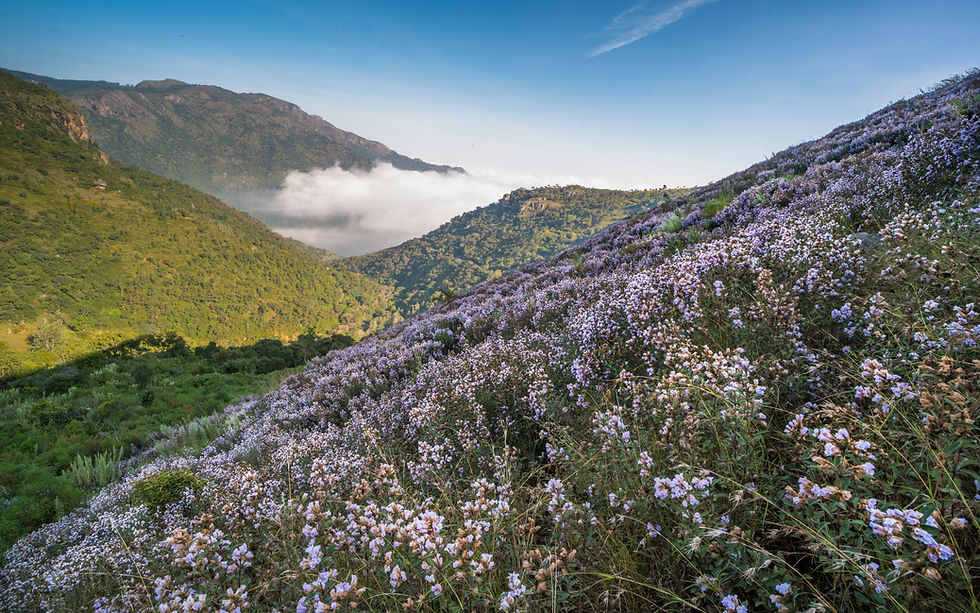
The Neela Kurinji — Strobilanthes kunthianus — is not just a beautiful flower. It is one of nature's most extraordinary events.
It grows as a shrub across the high-altitude grasslands of the Nilgiri, Anamalai, and Palani Hills in the Western Ghats. For most of its life, it looks like any other plant — green, unremarkable, easy to walk past. And then, every twelve years, something extraordinary happens. Every single shrub across entire hillsides bursts into bloom, all at once, as if they are all listening to the same silent signal. The hills turn purple. Or blue. Or somewhere in between — the kind of colour that doesn't quite have a name.
This is why the Nilgiri Hills are called the Nilgiris — which literally means "Blue Mountains." The name itself is the Kurinji's gift.
The blooming is triggered by a precise biological clock tied to the plant's lifecycle. Kurinji is monocarpic — it blooms once, produces seeds, and then dies. The seeds lie in wait, grow slowly for twelve years, and when the time comes, the cycle begins again. It is one of the longest mass-flowering events in the plant world, and scientists are still studying exactly how thousands of individual plants across vast distances manage to synchronise so perfectly.
The Toda tribe of the Nilgiris have known about this cycle far longer than science has. They used it to count time — measuring a person's age not in years, but in Kurinji blooms. "He is two blooms old," they would say. That is twenty-four years.
I had a chance to witness the Kurinji across different hillocks of Munnar in 2014 and 2018. Both times, the experience was different. Both times, unforgettable.
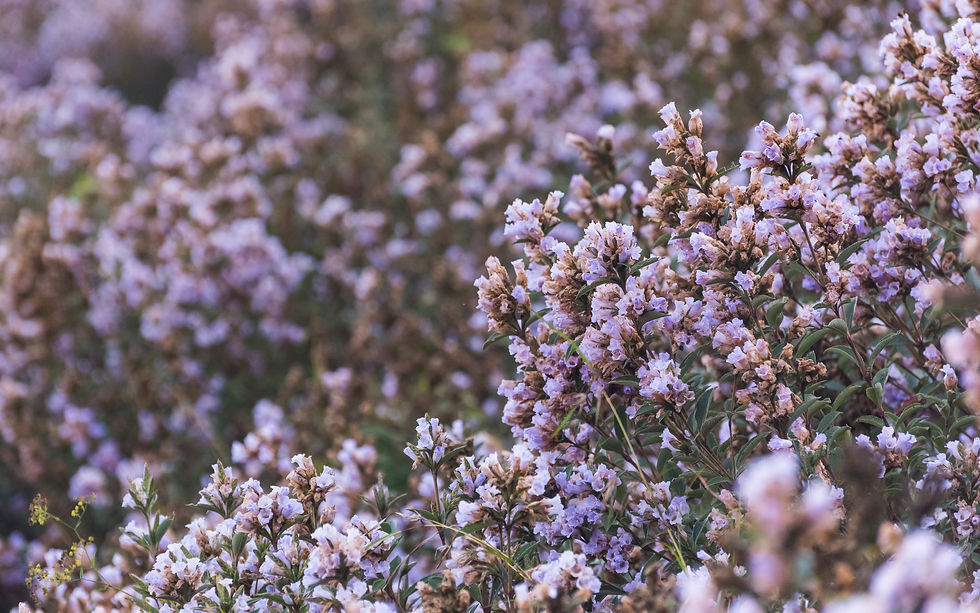
2018 — Eravikulam Visit

The 2018 bloom at Eravikulam was the most anticipated. This was the stronghold — the national park, the protected land, the place where the Kurinji and the Nilgiri Tahr share the same home.
But nature had other plans. The monsoon came hard and early. The bad weather spoiled much of what I had waited for. The bloom was patchy. The light was difficult. Some of the hillsides I had scouted in previous years were completely fogged out.
And yet.
The moments I did get — the frames I did gather — turned out to be some of the most meaningful of my photography life.
Because what Eravikulam gave me in 2018 was not just a Kurinji bloom. It gave me the full picture.

The Tahr — A Pride of the Western Ghats
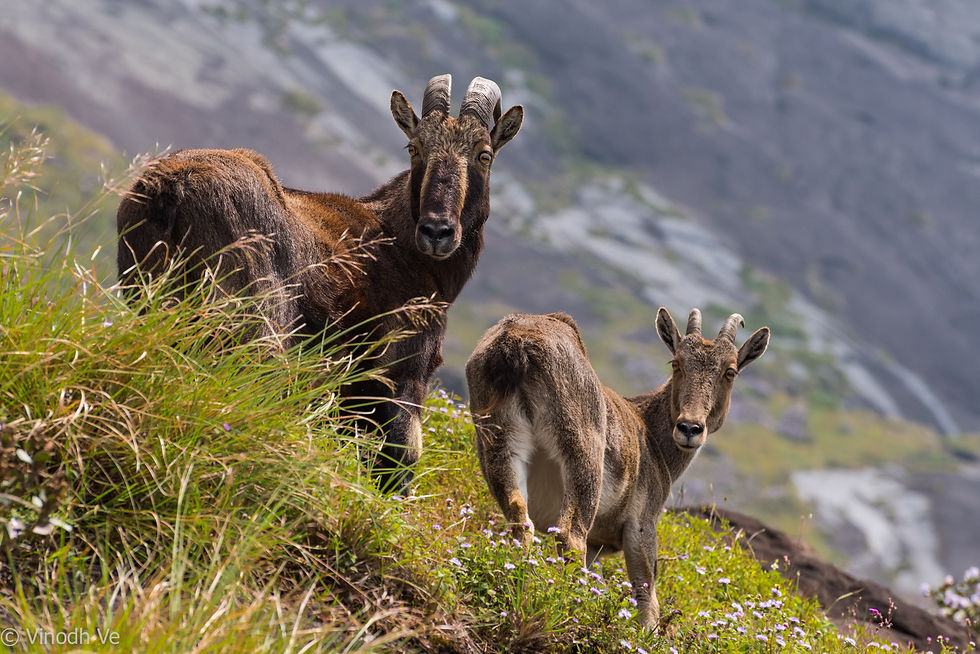
The Nilgiri Tahr — Nilgiritragus hylocrius — is one of the most iconic animals of the Western Ghats. Stocky, sure-footed, with curved horns that tell the story of their years — they look like they were built specifically for these rocky, wind-swept highlands. Because they were.
They are found nowhere else on earth. Strictly endemic to the Western Ghats, confined to the high-altitude grasslands of Kerala and Tamil Nadu. Once abundant across these hills, their numbers fell sharply due to hunting and habitat loss. Today, approximately 3,000 individuals remain in the wild. Eravikulam National Park holds the largest single population — around 750 to 800 animals — making this park arguably their most important refuge on the planet.
The adult males are called saddlebacks — named for the pale saddle-shaped patch that develops on their backs as they mature. It is a mark of age, of dominance. You learn to spot them from a distance.
Seeing a Tahr at Eravikulam is not rare. Locals will tell you that, and they are right. But seeing the Tahr here, in this place, during the Kurinji bloom — that is something else entirely.
When Two Special Things Meet
I had come hoping for both. What I did not expect was the scale of what I found.
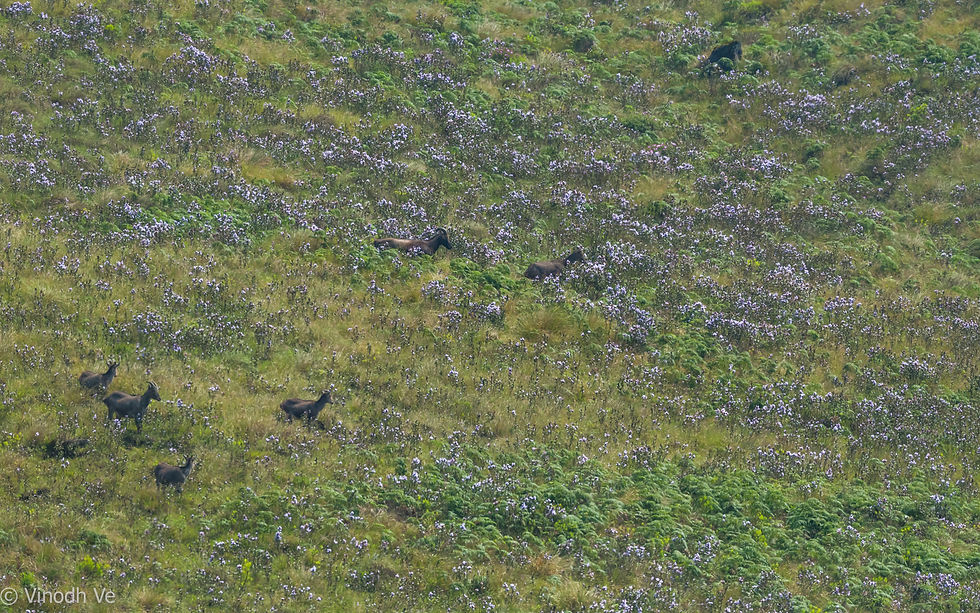
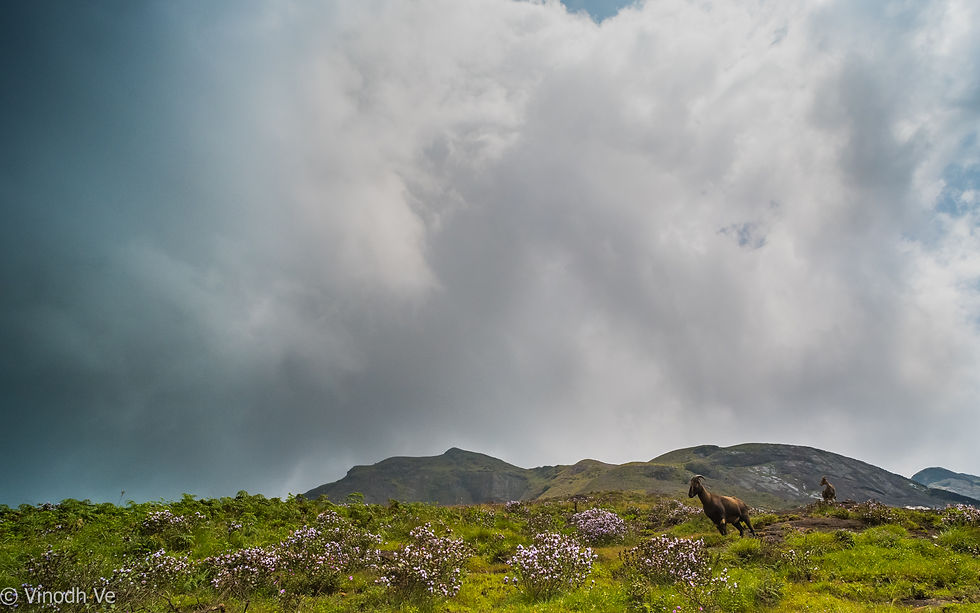
A herd of more than thirty Tahrs, moving through the kurinji-covered cliffs — grazing, chasing each other, resting, living their lives in the middle of a purple-carpeted landscape. Some were lying down among the flowers. Some were moving across the upper ridgeline. And somewhere in the middle of it all, a saddleback male was chasing a female, persistent and shameless, weaving through the blooming shrubs like a hero chasing his heroine through a field of wildflowers in some old movie.
I stood there quietly, with a smile.
Because what I was watching was not a spectacle put on for visiting photographers. It was just life — ancient, unhurried, completely indifferent to how rare it all was. The Tahr did not know that the Kurinji blooms only once in twelve years. They did not know that people had waited for this their whole lives. They were just home.

Why They Need Each Other

This is the part that took me time to appreciate: the Tahr and the Kurinji are not just sharing the same postcard. They are genuinely connected — ecologically, deeply, over thousands of years.
The Nilgiri Tahr are grazers. They feed on the high-altitude grasses and keep them from overgrowing the open grassland. This matters enormously, because the Kurinji is a grassland plant. Without grazing animals maintaining the open character of these slopes, dense vegetation would eventually crowd out the shrubs, and the bloom — when it comes — would have far less room to flourish.
The tahr also fertilise the soil through their droppings as they move across the grassland. And as a large herd travels across the hillsides, they inadvertently carry seeds and disturb the ground in ways that help new plants establish. The Kurinji's success, in some measure, is the Tahr's doing.
In turn, the Kurinji bloom — a massive simultaneous flowering event — produces enormous quantities of nectar that sustains bees, butterflies, birds, and insects across the park. This burst of biological activity ripples through the food chain. Everything feeds on something, and the kurinji's bloom triggers a kind of seasonal abundance that benefits the entire ecosystem — including the animals that graze on the grasslands where the kurinji grows.
This is the shola-grassland ecosystem — one of the most biodiverse and least understood habitats in the world. Mosaic patches of dense forest (shola) interspersed with open rolling grassland. Ancient. Fragile. Irreplaceable.
More Than Beautiful — Essential

Here is something most visitors to Munnar do not know.
The Western Ghats — this mountain range that runs down the spine of peninsular India — is the source of water for millions of people. The rivers that feed Karnataka, Kerala, and Tamil Nadu are born in these hills. The Periyar. The Kaveri. The Bharathapuzha. They begin as streams trickling through shola forests and high grasslands like the ones in Eravikulam.
The grasslands hold water. The forests hold the soil that holds the water. The animals — the Tahr, the gaur, the elephants — maintain the health of that ecosystem. Remove one thread and the fabric begins to unravel.
When we protect Eravikulam, we are not just protecting a beautiful place for photographers and tourists. We are protecting the watershed that keeps the taps running in cities hundreds of kilometres away. We are protecting the biodiversity that stabilises our climate at a local level. We are protecting the soil that grows the crops that feed us.
The Kurinji and the tahr are not just symbols of the Western Ghats. They are indicators of its health. When they thrive, the ecosystem thrives. When they struggle, something is wrong — and we should pay attention.
There are invasive species like wattle and eucalyptus spreading across these grasslands, crowding out native plants including the Kurinji. Climate change is beginning to alter the rainfall patterns these mountains depend on. Tourism — ironically, driven by the very beauty people come to see — puts pressure on fragile habitats if not managed carefully.
The next Kurinji bloom is expected around 2030. Will the hills look the same? Will the grasslands be as open? Will the herd of thirty tahrs still be there, grazing and chasing each other through the purple flowers?
That is not a question only for scientists and forest officials. It is a question for all of us.
What I Carry Home
What I carry home is not any single frame.
It is the saddleback Tahr chasing the female through the wildflowers like he had no dignity and no regrets. It is the young Tahr resting with its face just above a cluster of Kurinji in bloom, looking sideways at nothing in particular.
It is knowing the hills will do this again in twelve years, completely indifferent to whether anyone is watching — and feeling grateful that this time, I was.
We are guests here. And keeping it beautiful is not a favour we do for nature. It is something we do for ourselves.
Comments