Scorpions: A glowing mystery
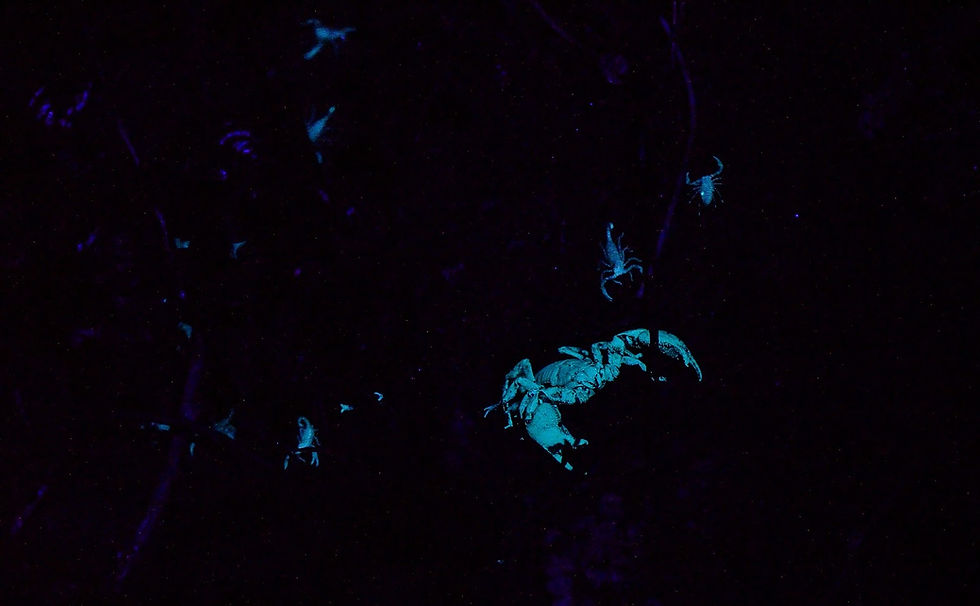
Did you know? All scorpions glow under UV light!!

Yes! Be it a scorpion from rainforest or from the desert, all of them glow into bluish green neon colour under ultra-violet light.

Scorpions are predominantly nocturnals, which means, active during night. They take shelter during day in the holes of mud walls or under the rock. They are both predators as well as prey at the same time - they hunt other insects like locusts or hoppers to feed, as well as, they are favourite prey for many species starting from bigger insects, birds like Rollers and mammals like Mangooses and Foxes. So they have to have their own way of survival skills. Scorpions live a secret life like most predators in the lower food chain. Their behaviour of glowing under UV light must be a way it had chosen for its survival.

Researchers have understood "HOW" it glows, but don't have a confident answer for the question "WHY". Though the reason is not known clearly why a scorpion glow under UV light, there are different hypothesis to this behaviour. Some of them are here:One theory is scorpions use their glowing exoskeleton under moonlight as one big eye to know if its completely exposed or protected/covered. If they feel they are glowing, which means they are exposed and are vulnerable and so they have to find shelter. Now, people whose sun sign is scorpio, you guys can try out on a night if you are glowing under UV light... :P
Some references on this topic - Why would a scorpion glow under UV Light, from Google:
Reference:
Their glowing bodies might serve as one big eye, helping scorpions find shelter under rocks, logs or grasses on moonlit nights, according to a 2012 study published in "Animal Behaviour." Led by Douglas Gaffin from the University of Oklahoma, this study showed that scorpions would scurry around in the dark until part of their bodies fell under the shadow of shelter. When shelter was scarce, scorpions preferred even a single blade of grass that cast just a small shadow to sitting completely exposed in the moonlight. This might be because the glowing exoskeleton helps the scorpions see by passing information to the brain on the amount of glow; when the exoskeleton glows more, the scorpion is in greater danger of predation. When there's no glow, the scorpion is sheltered from predators.Scorpions don't have the best eyesight. They see mostly in the blue-green spectrum. In 2011, Carl Kloock of California State University began leading research on why scorpions glow. His research leads scientists to believe the glow might be an adaptation that allows scorpions to know when they've found safe shelter. Kloock studied the behavior of scorpions who could glow and those who had lost the ability. The glowing ones found shelter in the dark quickly, while those who couldn't glow tended to roam more.
Reference:
California State University arachnologist Carl Kloock thinks otherwise. Over the past few months, Kloock and his colleagues have started unraveling the mystery of why scorpions glow."They may be using UV as a way to determine whether or not to come to the surface to look for prey, based on the light levels," Kloock told Life's Little Mysteries, a sister site to LiveScience.Scorpions are nocturnal creatures. They abhor the heat and evaporative effects of sunlight, and it turns out they specifically avoid UV light too. In a recent issue of the Journal of Arachnology, the Cal State team reported that the arachnids adjust their activity level depending on the amount of UV shining on them. When flooded in UV, they are less active than when lights are dim."My thinking at this point for why they would respond to UV is that there is a UV component in moonlight," Kloock wrote in an email. If scorpions are hungry, he explained, they'll come out and hunt regardless of light levels. But if they're satiated, research shows they tend to lie low on moonlit nights, especially around the time of the full moon. "[Fluorescence] may be part of the mechanism by which the scorpions respond to moonlight," Kloock wrote.
Comments